

Quick answer: To tell if you have hail damage on your roof, check from the ground first. You do not need a ladder. Look for these five signs:
- Granules in your gutters and downspouts that look like coarse black sand
- Round dents in soft metals such as AC fins, window screens, and mailboxes
- Dings in aluminum fascia and gutters along the roof edge
- Splatter marks on the storm-facing siding where hail knocked off dirt
- Bruised or cracked ridge cap shingles at the peak, visible from the driveway
If two or three of these show up, you very likely have hail damage. Then do this: document everything with dated photos, verify the storm date with a weather record, and call a local roofer for a free inspection before you call your insurance company.
I have walked thousands of roofs across Medina, Cuyahoga, Lorain, and Summit Counties, and hail is the damage homeowners miss most often. A wind-torn shingle is obvious. Hail is quiet. It bruises the mat under the surface, knocks the protective granules loose, and leaves a roof that looks mostly fine from the curb while it quietly ages years ahead of schedule. This guide shows you exactly how to tell if you have hail damage on your roof from the ground, what real hail damage looks like up close, and the steps that protect your wallet when you file a claim here in Ohio.
Why hail damage matters more in Northeast Ohio than most people think
Medina, Cuyahoga, Lorain, and Summit Counties sit in a Great Lakes storm corridor. The lakes feed moisture into spring and summer thunderstorms, and that funnel produces hail more often than a lot of homeowners realize. This is not a once-in-a-decade event around here. The region can see multiple hail events in a single warm season, and a single bad cell can hammer one neighborhood while leaving the next subdivision untouched.
That local reality is why I tell people not to wait for an obvious leak. By the time hail damage turns into a ceiling stain, you have lost months or years of roof life and possibly missed your claim window. Catching it early is the whole game. If a storm just rolled through your area, this is the moment to look, not next spring.
How to tell if you have hail damage on your roof from the ground
You can do a real, useful inspection without a ladder. Here is the ground level checklist I walk homeowners through. Work it in order.
- Check your gutters and downspouts. This is the single most reliable ground level tell. Hail knocks the granules off your shingles, and those granules wash into the gutters and pile at the bottom of downspouts. Look for buildup that resembles coarse black or gray sand. A handful of granules after a normal rain is routine. Heavy piles right after a storm are a red flag.
- Inspect the soft metals near the house. Hail leaves the clearest dents on soft, exposed metal. Look at your air conditioner condenser fins, window screens, mailbox, and any metal vents or caps you can see. Round dents on those surfaces tell you the hail was large enough and hard enough to bruise shingles too.
- Look at the aluminum fascia and gutters for dents. Run your eye along the metal trim wrapping the edge of the roof. Dimples and dings in aluminum fascia are a strong indicator that the roof above took the same hits.
- Check the siding for splatter marks. On the storm-facing side of the house, hail often leaves circular clean spots or pockmarks on siding where it knocked off dirt and chalk. Splatter on the siding means the roof slope above it got hit at the same angle.
- Study the ridge cap shingles from the driveway. The ridge caps run along the very peak of the roof, and you can usually see them from the ground. They are your fastest diagnostic shortcut, which I explain next.
If two or three of these checks come back positive, you very likely have hail damage. The next move is a real storm damage inspection from a roofer who knows what an adjuster looks for, not a guess from the curb.
The ridge cap shortcut: the fastest ground-to-roof tell
Here is a trick most homeowners never hear. Ridge cap shingles are thinner than the field shingles across the rest of your roof, and they sit fully exposed at the peak with nothing protecting them. That makes them the first thing hail bruises and cracks. If you can see bruising, cracking, or knocked-loose granules on the ridge caps from your driveway, the field shingles below them have almost certainly taken damage too. The ridge cap is the canary. When it goes, the rest of the roof has a story to tell.
What does hail damage look like on asphalt shingles up close?
If you do get a close look, or when your roofer shows you photos, here is what genuine hail damage looks like on asphalt shingles. Knowing the difference between storm damage and normal aging matters, because adjusters use that exact distinction to approve or deny a claim.
- Circular bruising that feels soft. Press a thumb near a hail hit and it feels like a bruise on an apple: a soft, dented spot where the impact fractured the mat underneath. That softness is the tell.
- Black or shiny exposed asphalt. Where hail knocks the granules clean off, you see the dark, sometimes shiny asphalt mat underneath. Fresh exposed mat looks different from the dull, weathered surface of an old roof.
- Cracks and splits with sharp, clean edges. Storm cracks have sharp edges and no weathering. Age cracks are dull and rounded. If the edges look freshly torn, that points to recent impact, not wear.
What size hail causes roof damage?
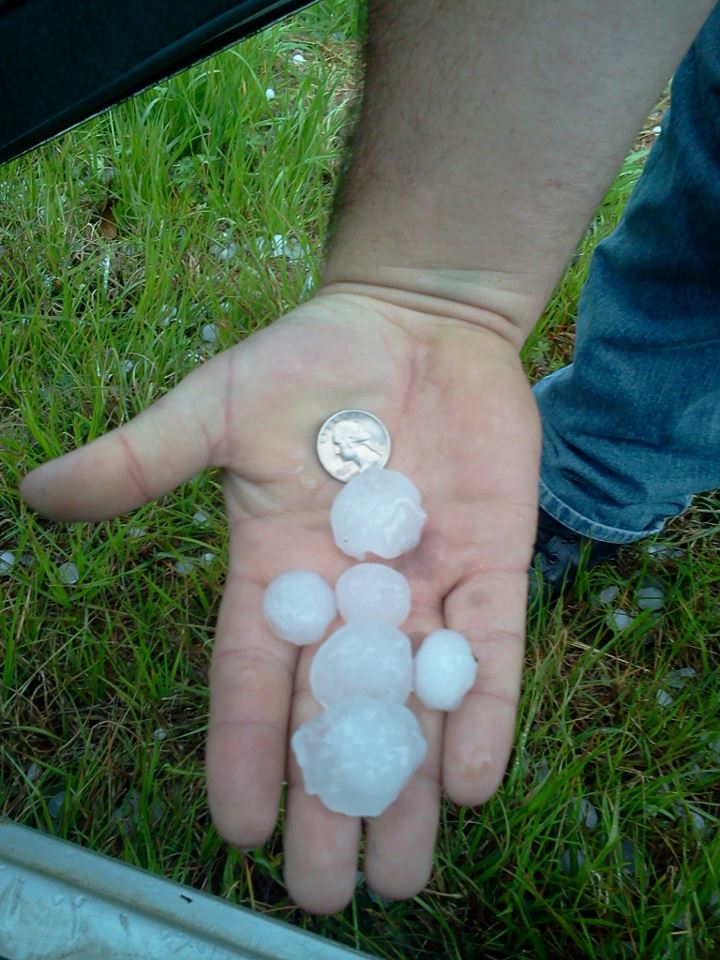
The general threshold for asphalt shingle damage is one inch, which is quarter-sized hail. Bigger hail does more damage, and golf-ball or larger hail can be brutal. That said, do not assume small hail is harmless. Marginal hail driven by high wind hits at a sharper angle and harder velocity, and it can still bruise shingles and strip granules. Wind and hail usually travel together in Ohio storms, so size alone is not the full story.
Why granule loss is a slow-motion roof failure
Granule loss in gutters is more than cosmetic, and this is the part competitors skip. Those granules are not decoration. They are the UV shield that protects the asphalt layer underneath from the sun. Once hail knocks enough of them loose, the bare asphalt starts oxidizing and drying out faster. A roof that is not leaking today can still be aging years ahead of schedule because of that exposure. This is exactly why a roof that looks mostly fine can still warrant full replacement. The damage is happening under the surface, on a clock, whether or not water is coming through yet.
And yes, unaddressed hail damage can absolutely cause leaks later. Cracked shingles and exposed mat are entry points. Water finds them eventually, often during the next freeze-thaw cycle when ice works into the cracks. If you suspect hits, do not wait for a leak to confirm it. A roof repair caught early is far cheaper than the interior damage that follows a leak you let ride.
What to do next after a hailstorm: the right order
Finding the damage is half the job. What you do in the days after a storm decides whether your claim gets paid in full or fought down. Do these things in this order.
1. Document before anything is touched
Photograph everything before a single repair or cleanup. Get every slope of the roof, all four siding elevations, the gutters, the AC unit, the window screens, and any interior water stains on ceilings or in the attic. Date-stamp the photos. Then verify the storm date with a weather record: NOAA storm data or a service like Weather Underground history for your specific zip code. Tying the damage to a documented storm date is what stops an adjuster from arguing the damage is old or cannot be pinned to a covered event.
2. Get a roof inspection before you call insurance
Yes, get the inspection first. A roofer who inspects before you file can tell you whether the damage is real, whether it is enough to justify a claim, and what an adjuster is likely to mark as functional versus cosmetic. That last point matters. If the damage is minor and below your deductible, you may not want a claim on your record at all. A free inspection costs you nothing and gives you the facts before you commit.
3. Understand functional versus cosmetic damage before the adjuster arrives
Insurance adjusters split hail damage into two buckets: functional and cosmetic. Functional damage compromises how the roof sheds water and protects the home. Cosmetic damage is dents that, in the carrier’s view, do not affect performance. Ohio carriers can and do deny replacement when they deem damage cosmetic only. The problem is that the line is judgment-based, and an unprepared homeowner has no leverage in that conversation. Knowing the distinction ahead of time, and having someone in your corner who can argue why bruising and granule loss are functional, is how you avoid getting talked down to a cosmetic denial.
4. Have your contractor present at the adjuster inspection
This is the single highest-leverage thing you can do, so I am putting it front and center. Have your roofer at the house when the insurance adjuster inspects. This is not adversarial, and adjusters expect it. One adjuster is covering a whole region after a storm and is moving fast. A contractor who works hail every season can point out hits the adjuster missed, push back when something legitimate gets marked cosmetic, and make sure soft-metal evidence and ridge cap damage get into the report. Claims get approved or denied on that walk. Be represented for it. This is the core of how we handle insurance claims for homeowners.
The Ohio insurance facts national articles never tell you
Most hail articles are written for a national audience and skip the rules that actually apply to you in Ohio. These three are the ones that catch local homeowners off guard.
You generally have one year to file in Ohio, and sometimes less
Most Ohio homeowner policies require you to file a hail claim within one year of the storm date. Some carriers impose even shorter windows, so do not assume you have a full year without checking your policy. File promptly regardless. The longer you wait, the easier it is for an adjuster to challenge the claim by arguing the damage cannot be tied to a specific storm. A documented storm date plus a prompt filing is your best defense. If a storm hit your area months ago and you never looked, check now while you may still be inside the window.
Ohio policies often carry a separate percentage-based wind or hail deductible
This one surprises people every season. Many Ohio policies do not apply your flat dollar deductible to wind and hail. Instead they carry a separate wind or hail deductible calculated as a percentage of your dwelling coverage, often in the range of one to two percent. On a home insured for 300,000 dollars, a two percent hail deductible is 6,000 dollars, not the 1,000 dollar flat deductible you assumed. Pull your declarations page and read the deductible section before you file so there are no surprises. Do not assume your standard deductible applies to a hail claim.
ACV versus RCV: why you will not get the full check upfront
Your coverage type changes how the money actually flows. Under Actual Cash Value (ACV), the insurer pays the depreciated value of the roof, meaning age is subtracted and you cover the gap. Under Replacement Cost Value (RCV), you are made whole for a new roof, but here is the mechanic almost nobody explains: the insurer pays the ACV amount first, holds back the depreciation, and releases that withheld depreciation only after the work is completed and documented. So even with good RCV coverage, you will not receive the full replacement amount in the first check. You get it in two payments, and the second one comes after the job is done and proven. Knowing this keeps you from panicking when the first check looks short.
What not to do after a hailstorm
The do-not list matters as much as the to-do list. After a storm, contractors descend on hail-hit neighborhoods, and not all of them have your interests in mind.
- Do not sign an assignment of benefits with a contractor you just met. A storm-chaser knocking your door an hour after the hail stops should not be handed control of your claim. An assignment of benefits signs your insurance rights over to them. Slow down.
- Do not climb the roof yourself. Hail-hit shingles can be loose and slick, and you can do more damage walking on them. The ground checklist gets you what you need. Leave the roof to someone insured to be up there.
- Do not make any repairs before the adjuster inspects. Tarping an active leak to prevent interior damage is fine and expected. Permanent repairs before the inspection erase the evidence the adjuster needs to see.
- Do not accept a cash settlement before you have a contractor estimate. The first offer is rarely the full scope. Get a real estimate so you know what the job actually costs before you agree to a number.
What a hail-damaged roof replacement actually costs in Northeast Ohio
Homeowners always want a number, so here is an honest, hedged one. A typical roof replacement in Northeast Ohio runs roughly 8,000 to 18,000 dollars, depending on the size of the home, the roof pitch, how many old layers have to come off, and the materials you choose. A large or steep home with multiple layers lands at the higher end. A modest ranch lands lower.
Here is the part that matters for a hail claim: when the damage is covered and you carry RCV, your out-of-pocket cost is often just your deductible. The insurance pays the rest, in the two-check sequence described above. That is the whole reason getting the claim approved correctly is worth the effort. The difference between a cosmetic denial and an approved replacement can be tens of thousands of dollars. If it comes to a full roof replacement, knowing your real cost exposure ahead of time keeps the process from feeling like a black box.
What Owens Corning Preferred Contractor status means for you
4K Roofing & Restoration is an Owens Corning Preferred Contractor. That is a credential a manufacturer does not hand out freely. It means we are factory-trained on their systems, vetted by Owens Corning, and eligible to register stronger warranties than a non-certified installer can offer. For a hail claim, that matters two ways: the installation is done to manufacturer spec, and the warranty coverage behind it is the real thing, not a handshake. It is one more reason to use a local, established contractor rather than an out-of-town crew that will be gone by next season.
On the local part: 4K Roofing & Restoration has been in business for ten years, and the owner and crew bring more than 25 years of roofing experience to every inspection. We are based in Medina and we work this hail corridor for a living. We know which storms hit which towns, because we were on those roofs.
Found signs of hail? Get a free inspection while you can still file
If your ground checklist turned up granules in the gutters, dings on the AC fins, or bruised ridge caps, do not sit on it. The Ohio claim window is shorter than most people assume, and damage only gets worse through the next freeze-thaw cycle. A free inspection tells you exactly what you are dealing with, with photos an adjuster will respect, before you ever file.
Call 4K Roofing & Restoration at 216.469.0863 for a free hail damage inspection. We serve 66 cities across Medina, Cuyahoga, Lorain, and Summit Counties, and we will stand with you at the adjuster meeting so your claim gets handled right the first time.
Frequently Asked Questions
How can I tell if my roof has hail damage without getting on it?
You can spot most hail damage from the ground. Check your gutters and downspouts for piles of shingle granules that look like coarse black sand, look at soft metals like AC fins and window screens for round dents, scan aluminum fascia for dings, check the storm-facing siding for splatter marks, and study the ridge cap shingles at the peak from your driveway. If the ridge caps show bruising or cracking, the rest of the roof almost certainly took damage too. If two or three of these come back positive, call a roofer for a full inspection.
What does hail damage look like on asphalt shingles?
Genuine hail damage shows up as circular bruising that feels soft when pressed, like a bruise on an apple, where the impact fractured the mat underneath. You will also see black or shiny exposed asphalt where granules were knocked off, and cracks or splits with sharp, clean edges and no weathering. Sharp fresh edges point to recent storm impact, while dull rounded cracks usually mean normal aging.
What size hail causes roof damage?
One inch hail, roughly quarter-sized, is the general threshold for asphalt shingle damage. Larger hail does more harm, but do not assume small hail is harmless. Marginal hail driven by high wind hits harder and at a sharper angle and can still bruise shingles and strip granules. In Ohio storms, wind and hail usually travel together, so size alone does not tell the whole story.
How long do I have to file a hail damage insurance claim in Ohio?
Most Ohio homeowner policies require you to file a hail claim within one year of the storm date, and some carriers impose even shorter windows. Check your specific policy and do not assume you have a full year. File promptly, because the longer you wait, the easier it is for an adjuster to challenge the claim by arguing the damage cannot be tied to a specific storm. A documented storm date plus a prompt filing is your best protection.
What is the difference between ACV and RCV coverage for a hail-damaged roof?
Under Actual Cash Value (ACV), the insurer pays the depreciated value of your roof, so age is subtracted and you cover the gap. Under Replacement Cost Value (RCV), you are made whole for a new roof, but the money comes in two parts: the insurer pays the ACV amount first, holds back the depreciation, and releases that withheld amount only after the work is completed and documented. Even with RCV, you will not receive the full replacement amount in the first check.
Should I get a roof inspection before calling my insurance company?
Yes. A roofer who inspects before you file can confirm whether the damage is real, whether it justifies a claim, and what an adjuster is likely to mark as functional versus cosmetic. If the damage is minor and below your deductible, you may not want a claim on your record at all. A free inspection costs nothing and gives you the facts before you commit to filing.