

How Long Does a Roof Last in Northeast Ohio? (And How to Tell When Yours Is Done)
- Mike Kvak

- Jun 15
- 6 min read
If you search "how long does a roof last," you'll get the same answer everywhere: 20 to 30 years for asphalt shingles. That number isn't wrong. It's just not the full picture for anyone living in Medina, Summit, Cuyahoga, or Lorain County.
Northeast Ohio is one of the hardest roofing climates in the country. 40 to 60 freeze-thaw cycles per year. Lake-effect snow loads. Hail seasons that track directly across Medina and Summit counties moving east off Lake Erie. The roofs we inspect that were installed in the late 1990s and early 2000s, many of them are done. Not because the material failed in a vacuum, but because this climate doesn't give roofs the same runway it gives homes in Virginia or Texas.
Here's what actually determines how long your roof lasts here, and what to look for when you think it might be time.
What the Manufacturer's Warranty Actually Means
A 30-year shingle warranty is a materials warranty. Not a performance guarantee. It covers manufacturing defects under controlled conditions. It doesn't account for how your attic is ventilated, how the shingles were installed, or how many hail events they've absorbed since 2010.
Owens Corning's Duration shingles, which is what 4K installs on most replacements, carry a lifetime limited warranty. The product is genuinely good. But "lifetime" means the shingle won't delaminate or lose granules due to a factory defect. It doesn't mean your roof will last 50 years regardless of what happens above and below it.
The practical lifespan of a roof in Northeast Ohio comes down to four variables: material, installation quality, attic ventilation, and accumulated weather stress. You control the first three. You don't control the fourth.
Roofing Material Lifespan in Northeast Ohio
The gap between what manufacturers advertise and what roofs actually deliver in this climate is real. Here's the honest breakdown by material.
Most homes in Medina County, especially anything built between 1985 and 2005, have architectural asphalt shingles. That puts a significant portion of the housing stock in Brunswick, Wadsworth, Strongsville, and Medina itself either approaching or past replacement age right now.

3-tab shingles are the clearest case. They were the standard install through the 1990s: thinner, lighter, and cheaper than dimensional shingles. They also have a single flat profile that gives wind and ice a better grip. In a climate like ours, they rarely make it to 20 years in good shape. If your home was built before 2000 and has never had a roof replacement, there's a reasonable chance you're still on original 3-tabs.
How Old Is Your Roof? Find Your Build Year Below
If you're not sure when your roof was last replaced, your home's build year is a reasonable starting point. County auditor records show year built for every parcel in Medina, Summit, Cuyahoga, and Lorain counties; and they're free to look up.
One important note: build year is not the same as last replacement date. Many homes in Medina County had roofs replaced after the 2011 hail season, the April 2019 outbreak, or the storm activity in 2023. If you bought your home and don't have records, check with the previous owners or pull the permit history through Medina County Building Department.
What Kills Roofs Early in Northeast Ohio
Freeze-Thaw Cycles: The Slow Grind
This is the biggest one and the least visible. Northeast Ohio averages 40 to 60 freeze-thaw cycles per year. Each cycle works the same way: water infiltrates a small gap, under a lifted shingle seal, around a flashing edge, at the ridge, then freezes overnight and expands by roughly 9%. That expansion widens the gap. Water gets deeper on the next cycle. Repeat 50 times in a single winter.
The roofs that hold up the longest against freeze-thaw share two things: ice and water shield installed at the eaves and in the valleys, and properly balanced attic ventilation. Without ventilation, warm air from the living space rises, heats the roof deck unevenly, melts snow at the peak, and that water runs down and refreezes at the cold eaves. Ice dams. They don't just damage shingles. They force water backward under the shingle course and straight into the decking.
Hail — The Silent Accelerant
Medina, Summit, Cuyahoga, and Lorain counties sit in the primary storm corridor moving east off Lake Erie. Most hail events here don't make the news. Dime-sized stones, a 20-minute cell, and then it's gone. The damage isn't obvious the next morning. But a single event can strip the protective granule coating from a shingle field without leaving a dent visible from the ground.
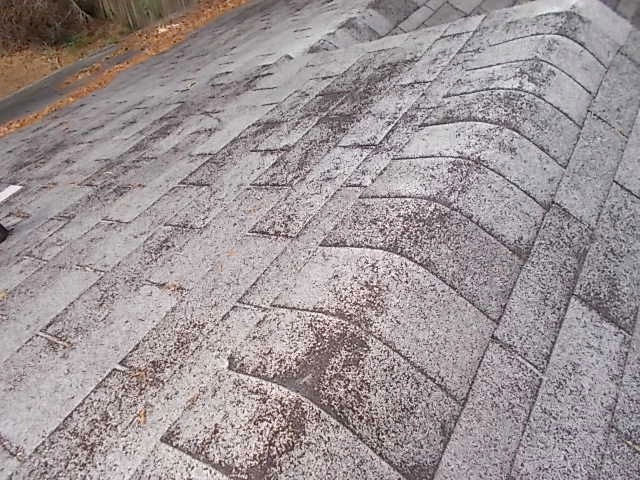
Granules are what protect the asphalt layer from UV degradation. Lose enough of them and you've cut years off the roof's remaining life. The roof doesn't fail that week. It fails 3 to 5 years earlier than it should have. And by that point, the storm that caused it is long outside your insurance claim window.
Installation Failures
Bad installation isn't always obvious at completion. Shingles nailed too high, above the nail strip, lose their wind resistance almost immediately. No starter strip at the eaves means the first course of shingles has no sealant bond underneath. Flashing lapped the wrong direction at a chimney or in a valley creates a water trap that fills every rain. Each of these is invisible on completion day. Each of them is an active failure point after a few Ohio winters.
The Warning Signs: What to Look for Before Calling Anyone
You don't need a contractor to do the first pass. Most of these are visible from the ground or from your attic.
Repair or Replace? The Honest Decision Guide
This is the question we get on almost every inspection. The answer isn't the same for every roof, but the decision framework is straightforward.
The gray zone is 15 to 18 years. Roofs in that range need an inspection, not a guess. Repairing a 17-year-old roof with widespread granule loss is putting money into a system that's declining across the whole field, not just in one spot. The repair cost at year 17 is money not applied toward replacement at year 20. We've had this conversation with a lot of homeowners in Medina and Brunswick. The ones who wait for a dramatic failure end up with interior damage on top of a replacement bill.

If you're in the gray zone and you've had any significant storm activity in the last two years, there's also the insurance angle to consider. A viable claim changes the math entirely. We walk through that process on every job we do.
What a Proper Replacement Actually Includes
This section doesn't exist on most roofing sites. It should, because it's where homeowners get burned most often. A cheap installation on good shingles will fail early. Here's what a full replacement should include, and what 4K does on every job.
Most of what separates a 20-year roof from a 27-year roof isn't the shingle. It's everything underneath and around it.
What 4K Checks on a Free Inspection
When we do a free inspection in Medina County, we're not looking for a reason to sell you a roof. We're looking at the whole system: shingle condition across all planes, granule retention, flashing integrity at every penetration point, ridge and soffit ventilation, decking condition where accessible, gutter attachment, and drainage.
You get a written report. No pressure, no commitment required.
If there's storm damage with a viable insurance claim, we'll tell you. If the roof has 5 good years left, we'll tell you that too. The goal is that you leave knowing exactly what you have and what you're deciding between.
Roofs in Northeast Ohio don't fail on a schedule. But they give signals. The homeowners who act on those signals early, who get an inspection at 15 years, who call us after a hail event, who check the attic once a year, are the ones making decisions instead of reacting to emergencies.
Schedule a free inspection or call us directly at 216.469.0863.
Frequently Asked Questions
How long do roofs last in Medina, Ohio specifically?
Most asphalt shingle roofs in Medina County last between 18 and 27 years depending on shingle type, installation quality, and storm history. Architectural shingles installed with proper ventilation and ice shield sit at the higher end. 3-tab shingles or any roof with ventilation problems will come in well below it.
Does homeowner's insurance cover roof replacement in Ohio?
It depends on the cause. Storm damage, hail, wind, falling trees, is typically covered under a standard Ohio homeowner's policy. Age and general wear are not. Ohio's post-storm filing window is 1 to 2 years, so timing matters significantly. We assist with the full insurance claim process on every storm damage job.
What's the best roofing material for Northeast Ohio weather?
For most homeowners, architectural asphalt shingles with a Class 4 impact rating give the best combination of performance, warranty value, and cost in this climate. Owens Corning Duration with SureNail technology is what 4K installs on most replacement, it's engineered for high-wind environments and handles freeze-thaw cycling better than standard architectural shingles.
How do I know if my roof needs replacement vs. repair?
Under 15 years with isolated damage, repair usually makes sense. Over 18 years with widespread degradation or multiple leak points, replacement is the better move. The 15 to 18-year window is where a professional inspection matters most. Start with a free inspection and get a straight answer before committing to either.
How much does a roof replacement cost in Medina, Ohio?
Cost varies based on roof size, pitch, shingle selection, and decking condition. We're working on a full breakdown for Medina County specifically. In the meantime, the most accurate starting point is a free estimate from 4K. We give you a written number before any work starts, with no obligation.


